
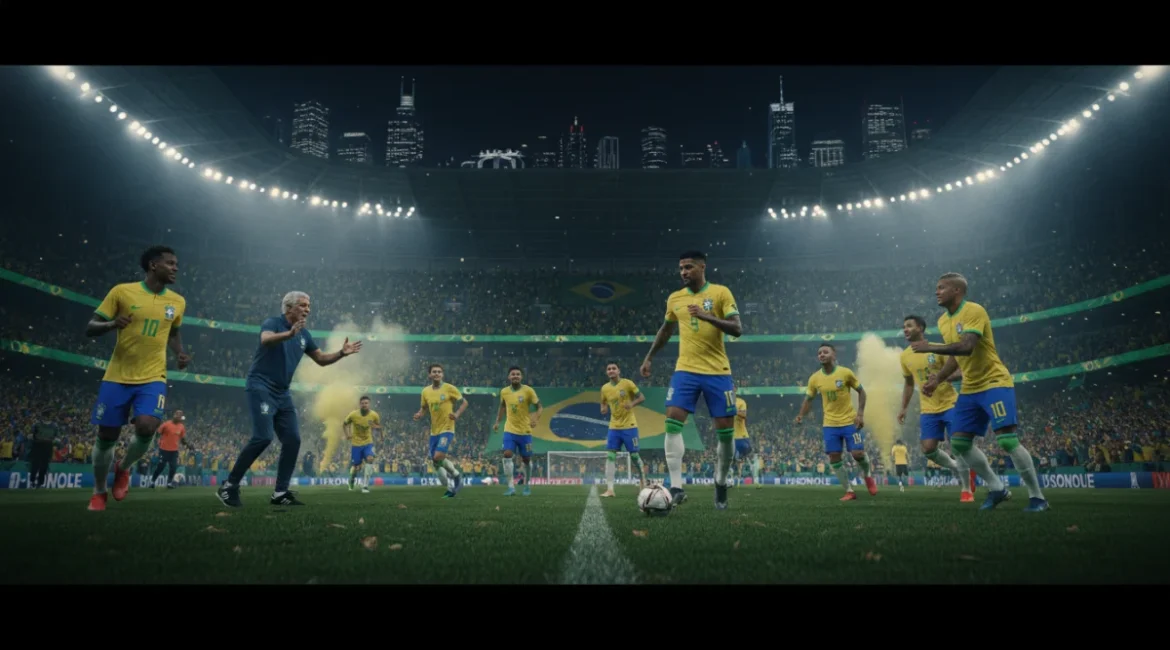
Carlo Ancelotti’s first major tournament in charge of Brazil is arriving with real weight behind it. The final 26-man squad for the 2026 World Cup is more than a routine roster announcement; it is the opening statement of a new era, one built around pressure, expectation, and a long wait for a sixth global crown.
Brazil have not won the World Cup since 2002, and every campaign since then has ended with the same frustration at the business end of the competition. That history makes every selection matter. Ancelotti entered the process with a preliminary pool of 55 players, then narrowed the field as injuries, form, and tactical balance forced difficult decisions.
The core group already looks settled
Even before the final announcement, several names appeared close to guaranteed. Alisson remains the clear first choice in goal, with Ederson positioned as the main alternative. In front of them, Marquinhos and Gabriel Magalhaes are the most natural center-back pairing, while Bremer and Leo Pereira provide additional depth if the squad needs a different profile.
The middle of the pitch also feels familiar. Casemiro brings leadership and defensive security, Bruno Guimaraes offers control and movement, and Lucas Paqueta adds the kind of creativity Brazil need between the lines. In attack, Vinicius Junior is the centerpiece, with Raphinha, Matheus Cunha, and Gabriel Martinelli all likely to be important to the team’s pace and directness.
At fullback, Wesley is widely expected to handle the right side after Vanderson’s absence, and Alex Sandro looks set to be the safer choice on the left. That combination suggests Ancelotti values reliability as much as flair, especially in a tournament where Brazil’s path could be decided by small margins.
Injuries changed the conversation
The final squad discussion would have been very different without the injuries that removed several high-profile players from contention. Rodrygo is out after knee ligament surgery and faces a long recovery. Estevao Willian also misses out after suffering a serious muscle problem in the spring. Eder Militao, meanwhile, remains sidelined with a longer-term knee issue.
Those absences did more than reduce depth; they changed the balance of the roster. Brazil lost a wide attacker, a young creative option, and a defensive leader all at once. That kind of disruption often creates openings for veterans, and in this case it placed Neymar back at the center of the debate.
Neymar’s place may define the final list
Neymar’s situation is one of the most discussed topics around the squad. He was included in the preliminary 55-man group even though he had not played for Brazil since his ACL and meniscus injury against Uruguay in October 2023. At 34, he is still Brazil’s all-time leading scorer with 79 goals in 128 appearances, which makes any decision about him feel significant.
Reports from Brazilian media and international outlets suggest Ancelotti is leaning toward bringing him to the tournament. The reasoning is practical as much as emotional: Brazil have injury gaps to fill, and Neymar’s recent form with Santos has offered enough encouragement to keep his name in the frame. Neymar himself has said he feels physically ready and believes he has done everything needed to earn selection.
If he makes the squad, the biggest casualty could be Joao Pedro, whose strong Premier League season might still not be enough to secure a place. That is the sort of decision that shows how crowded Brazil’s attacking options remain, even with several stars unavailable.
What Group C means for Brazil
Brazil open in Group C alongside Morocco, Haiti, and Scotland, a draw many observers see as manageable compared with past World Cup groups. Morocco is the most demanding opponent on paper, while Haiti and Scotland create very different tactical problems without carrying the same ranking weight.
- June 13: Brazil vs. Morocco at MetLife Stadium in East Rutherford, New Jersey.
- June 19 or 20: Brazil vs. Haiti at Lincoln Financial Field in Philadelphia.
- June 25 or 26: Scotland vs. Brazil at Hard Rock Stadium in Miami Gardens.
A strong start would matter because winning the group should lead to a more favorable Round of 32 matchup against one of the third-place qualifiers from another group. For a team with Brazil’s ambitions, that path is important even if the real test lies further ahead.
How Ancelotti may set the team up
Based on the March friendlies against France and Croatia, Brazil could line up in either a 4-2-3-1 or a 4-3-3. The back line would likely include Alisson behind Wesley, Marquinhos, Gabriel, and Alex Sandro, with Casemiro and Bruno Guimaraes anchoring the midfield.
In the more advanced roles, Raphinha, Paqueta, and Vinicius Junior offer a mix of work rate, creation, and direct threat, while Matheus Cunha or Igor Thiago could start as the central forward. If Neymar is selected, he would immediately complicate that picture by competing for the number 10 role or drifting into a false-nine position behind Vinicius.
Brazil enter the tournament as one of the favorites not because everything is perfect, but because the squad still combines elite talent, experience, and enough structure to compete with anyone. Ancelotti’s task is to turn that potential into a team that can finally end a 24-year wait.