
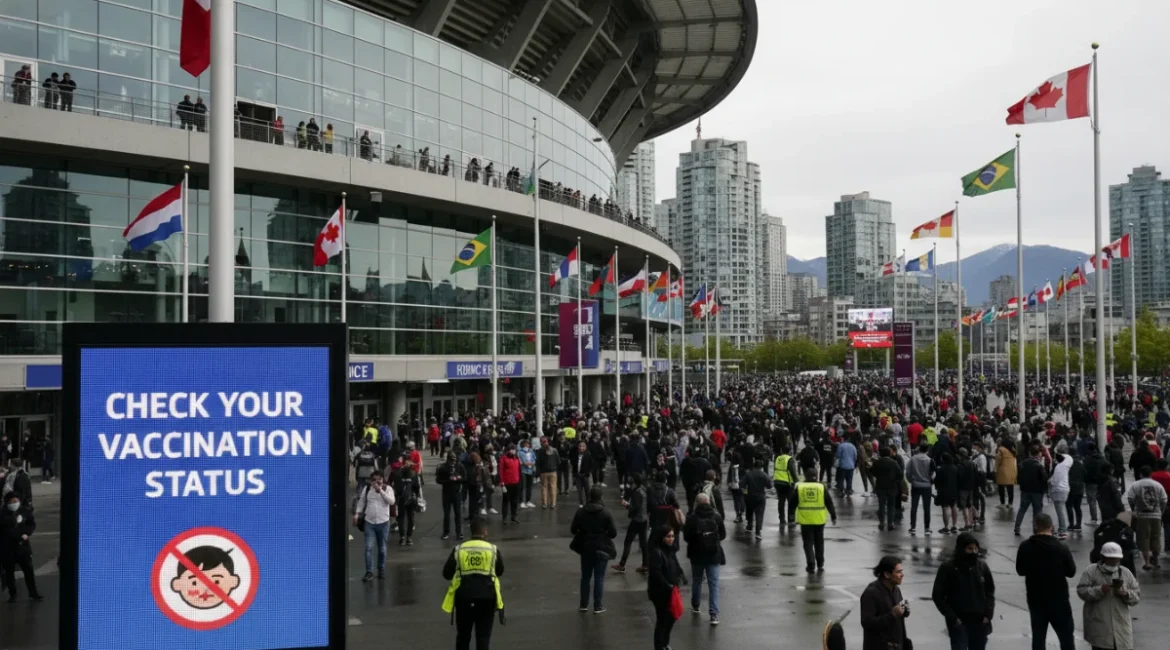
Health officials are urging caution as Vancouver prepares to welcome a surge of visitors for the FIFA World Cup, with measles emerging as one of the clearest public health worries. The concern is not about the tournament itself, but about what large international gatherings can do when a highly contagious virus meets crowded venues, busy transit, and travelers arriving from many regions at once.
The Public Health Agency of Canada has flagged measles as a disease that could be introduced into the country during the event. That concern is based on a few well-known facts: measles is still circulating in many parts of the world, it spreads through the air with ease, and even brief exposure in packed indoor settings can be enough to move it from one person to another.
Ontario has already released a detailed infectious disease risk review tied to the World Cup. That assessment points to international travel, dense crowds, and lower vaccination coverage as conditions that can help measles spread. British Columbia, by contrast, has not yet published a public version of its own review, which has raised questions among some doctors and health advocates.
Why Doctors Want Clearer Messaging Now
Dr. Brian Conway, medical director of the Vancouver Infectious Diseases Centre, says the lack of visible public communication in British Columbia is a missed opportunity. In his view, officials should be speaking plainly and early so that both residents and visitors understand the risk before the first major crowds arrive.
He argues that people should be encouraged to check their vaccination records now rather than waiting until they are already in the middle of tournament activity. Visitors should also be told that Canada is dealing with active measles transmission, because many people may assume the disease is no longer a concern in a country with strong health systems.
According to Conway, the goal is not panic. It is preparation. A short public reminder about measles protection, he says, could help prevent avoidable cases from becoming a larger problem during the event.
What the Numbers Say Across Canada
Canada has already recorded more than 900 measles cases in seven jurisdictions this year, with Alberta and Manitoba reporting the largest shares. Those numbers matter because they show the virus is not just a theoretical concern tied to foreign travel; it is already active inside the country.
The current outbreak follows a much larger one last year, when more than 5,000 people were infected. Health officials believe that surge began after a person in New Brunswick was exposed outside Canada in the fall of 2024 and later brought the virus home.
British Columbia has also seen significant activity. Provincial data shows 470 cases reported during 2025 and 2026, and about 80 percent of those infections were concentrated in northeastern B.C., where immunization rates are among the province’s lowest.
Why Large Events Create the Right Conditions
Public health experts say big sporting events are not automatically dangerous, but they do create conditions that can help an infectious disease move quickly if it appears. The combination of air travel, full stadiums, shared indoor spaces, and constant movement between hotels, restaurants, and transit hubs increases the number of people who may be exposed if one infected person is present.
- Visitors arrive from countries with different vaccination levels.
- Fans gather in crowded, high-contact spaces.
- Measles can spread before a person realizes they are sick.
- Under-vaccinated communities can turn one imported case into more cases.
That is why officials are paying attention now rather than waiting for the tournament to begin. The main concern is not a citywide crisis, but a preventable chain of transmission that could start quietly and then accelerate in the wrong setting.
Vancouver Has Seen This Pattern Before
Health experts are also looking back at Vancouver’s past. After the 2010 Winter Olympic Games, British Columbia recorded a measles outbreak with 82 confirmed cases. The circumstances were different, but the lesson remains relevant: major international events can connect people in ways that make disease spread easier.
Dr. Conway says the current situation may be even more concerning because vaccination rates have dropped in some parts of British Columbia. He also notes that some of the countries sending athletes, support staff, and fans to the World Cup may have lower measles coverage as well, increasing the chance that an infected traveler could arrive in Vancouver.
Local Health and City Officials Say Planning Is Underway
Vancouver Coastal Health says it has been preparing for the FIFA World Cup for years. The health authority says it has completed a public health risk assessment with the B.C. Centre for Disease Control, although the results have not been released to the public.
Dr. Mark Lysyshyn, deputy chief medical health officer with Vancouver Coastal Health, said the assessment placed the measles threat during the tournament in the medium-to-moderate range. He also said the region has already managed dozens of imported measles cases during the current outbreak without seeing continued spread locally.
In his view, strong immunization levels in the Vancouver Coastal Health region have helped prevent wider transmission. Because of that, he does not expect an imported World Cup case to be especially difficult to control, provided the response is quick and people remain alert.
What the City Says It Can Handle
The City of Vancouver says it has broad operational and emergency management plans ready for the tournament. Officials say those plans are intended to support a rapid response if any public health or safety issue appears during the event.
That planning includes coordination across agencies so the city can respond without delay if a case or exposure event requires action. In a setting as large and visible as the World Cup, officials say readiness matters as much as reaction.
Where the Greatest Risk Really Falls
Dr. Monika Naus, a professor at the University of British Columbia’s School of Population and Public Health, says the biggest risk is not spread across the entire population. Most adults are already protected through vaccination or previous infection, which lowers the chance of a broad community outbreak.
Instead, the main vulnerability lies in communities with lower immunization coverage. In British Columbia, those communities are often clustered geographically, which means measles can find pockets where it has a better chance of spreading if it is introduced.
- Most people are already immune, which lowers general risk.
- Low-coverage communities remain the most vulnerable.
- Clustered under-vaccination can allow localized outbreaks.
Why Vaccination Checks Matter Before Fans Arrive
Public health experts say one of the smartest steps residents and visitors can take is to confirm measles vaccination status before the tournament begins. Because measles is so contagious, prevention is far more effective than trying to contain spread after exposure has already occurred.
For Vancouver, the challenge is balancing the excitement of hosting a global event with the practical need to keep a preventable disease from moving through crowded spaces. The World Cup will bring energy, tourism, and international attention, but it will also demand careful public health awareness from everyone involved.
The message from experts is straightforward: know your vaccination history, update it if needed, and do not assume that a major event will be the only thing drawing people together. In the right circumstances, measles can spread quietly and quickly, which is exactly why early preparation matters.
Canada’s Elimination Status Is Already at Stake
The Public Health Agency of Canada said last year that the Pan American Health Organization informed the country it no longer holds measles elimination status. That designation is lost when transmission continues for an extended period rather than staying limited to isolated imported cases.
Canada can regain that status if measles transmission is interrupted for a full year. Until then, the country remains focused on containment, vaccination, and reducing the chances that imported cases will find the conditions they need to spread.