
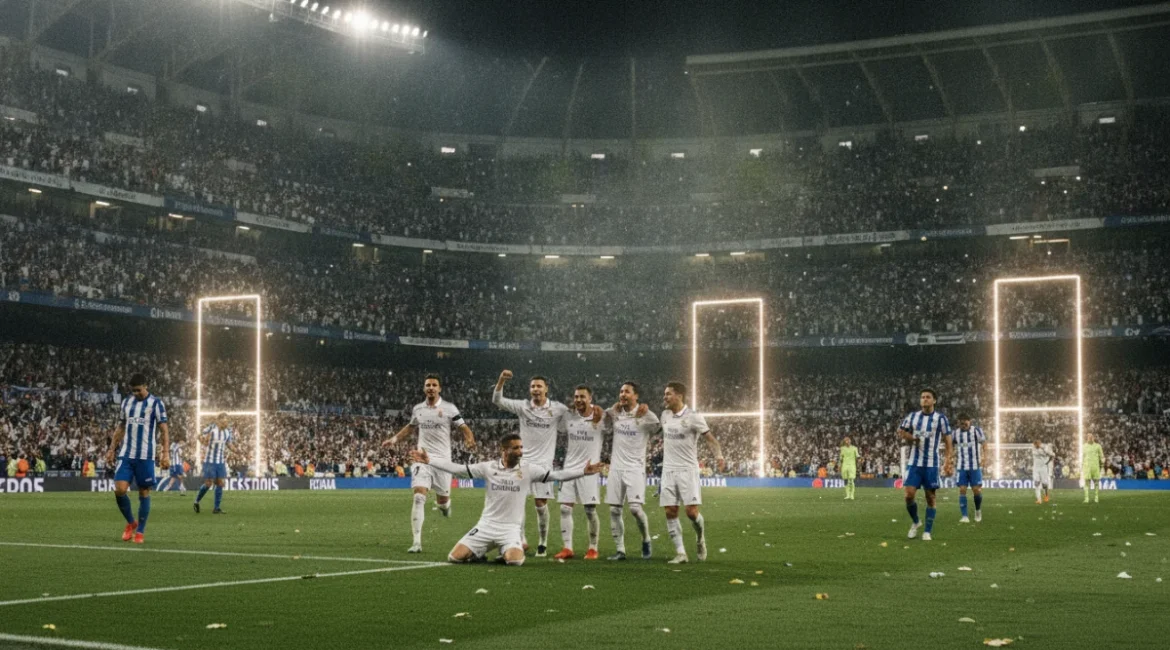
Real Madrid delivered a commanding 4-0 win over Malaga, blending sharp finishing, steady possession, and relentless pressure from start to finish. The result showed clear dominance in every major phase of the game.
Match Overview
Played on a sunny Sunday afternoon at the Bernabéu, the match quickly tilted in Madrid’s favor as the home side controlled the pace and created chances in waves. Malaga struggled to match the intensity and rarely threatened with any real consistency.
| Statistic | Real Madrid | Malaga | Context |
|---|---|---|---|
| Ball Possession (%) | 57 | 43 | Madrid controlled most of the tempo |
| Total Shots | 33 | 20 | Madrid generated more volume in attack |
| Shots on Target | 12 | 4 | Madrid’s accuracy created the difference |
| Expected Goals (xG) | 2.34 | 0.67 | Madrid produced the clearer scoring chances |
| Corner Kicks | 5 | 3 | More set-piece pressure for Madrid |
| Offsides | 2 | 11 | Malaga’s attacking runs were repeatedly caught |
| Fouls | 6 | 9 | A relatively clean match overall |
How the Goals Came
Early Breakthrough
Jude Bellingham opened the scoring in the 19th minute, giving Madrid immediate momentum and rewarding their quick passing in midfield. That early goal set the tone for a one-sided first half.
Pressure Forces an Own Goal
In the 26th minute, Malaga’s Herrero turned the ball into his own net after sustained Madrid pressure. The mistake widened the gap and made the visitors’ recovery far more difficult.
Mbappe Finishes the Move
Kylian Mbappe made it 3-0 in the 30th minute with a composed finish that reflected his pace, movement, and instinct inside the box. It was the kind of goal that punished every defensive lapse Malaga made.
Late Insurance
Arda Guler capped the performance with a stoppage-time strike in the 90+1 minute. The late goal emphasized Madrid’s refusal to ease off even with the result already decided.
Tactical Control and Match Rhythm
Real Madrid dictated the game through cleaner passing and stronger control in central areas, completing 596 passes compared with Malaga’s 446. That edge in circulation helped Madrid keep Malaga pinned back and limited the visitors’ ability to build sustained attacks.
The 33-shot total also shows how aggressively Madrid attacked throughout the match. With 12 efforts on target, they turned pressure into genuine danger far more efficiently than Malaga did.
Standout Performers
Bellingham was influential beyond his goal, linking midfield and attack with intelligence and timing. Mbappe added the kind of direct threat that kept Malaga constantly on edge, while Guler’s late finish highlighted Madrid’s depth and composure.
Carlo Ancelotti praised the team’s energy and balance, noting that Bellingham and Mbappe set the standard early and helped drive the team’s momentum.
What the Result Means
The victory strengthened Real Madrid’s early position in La Liga 2026 and reinforced their momentum heading into a demanding stretch of fixtures. It also sent a strong message about their ambitions in both domestic and European competition.
For Malaga, the defeat exposed defensive issues that need immediate attention. Improving structure at the back and reducing costly mistakes will be essential if they want to recover quickly.
Key Takeaways
- Real Madrid won 4-0 and controlled the match from the opening stages.
- Bellingham, Mbappe, Guler, and an own goal accounted for the scoring.
- Madrid led in possession, shots, shots on target, and xG.
- Malaga’s defensive shape broke down under sustained pressure.
- The result boosted Madrid’s confidence and league standing.
Frequently Asked Questions
What was the final score?
Real Madrid beat Malaga 4-0 on August 30, 2026.
Who scored for Real Madrid?
Bellingham scored in the 19th minute, Malaga’s Herrero scored an own goal in the 26th minute, Mbappe scored in the 30th minute, and Guler scored in stoppage time.
How did Real Madrid dominate the game?
Madrid controlled possession, produced more shots, landed more attempts on target, and created stronger scoring chances overall.
What hurt Malaga the most?
Repeated defensive errors, poor control in transition, and a lack of attacking precision made it difficult for Malaga to stay competitive.