
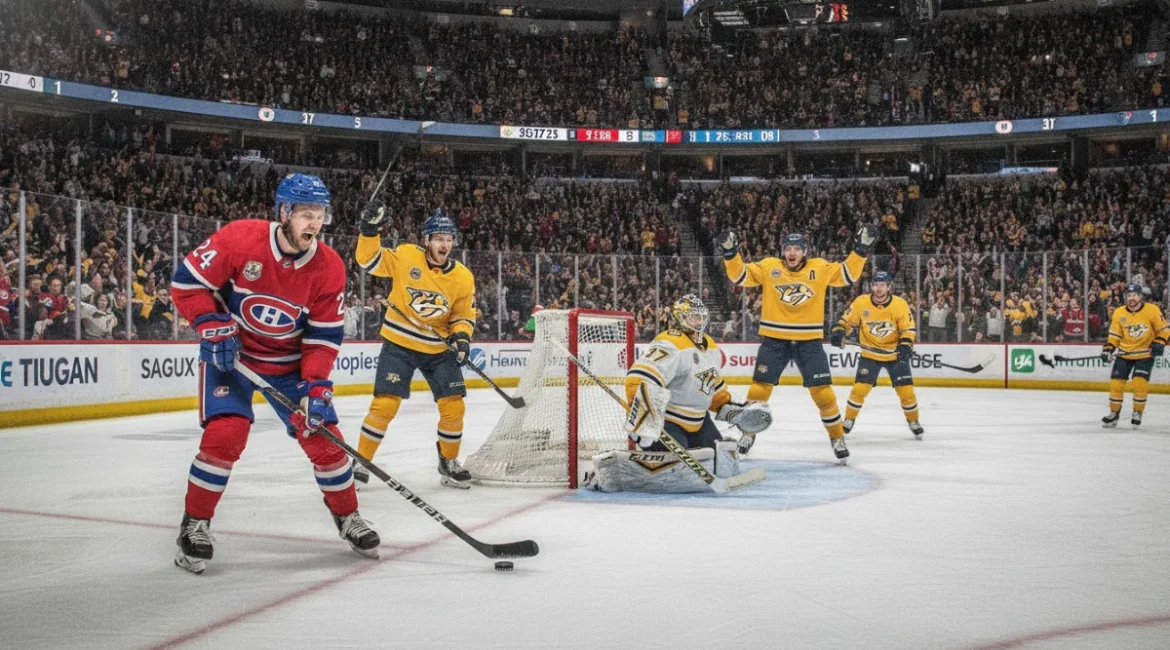
The Montreal Canadiens appeared to have Thursday’s matchup under control. They dictated play for long stretches at Bell Centre, created the better chances and established a 2-0 advantage against the Nashville Predators.
None of that was enough to secure a result. Nashville scored five consecutive goals, including Ryan O’Reilly’s late power-play marker, and completed a 5-2 comeback. The defeat extended Montreal’s winless run to three games and left the Canadiens with a 1-2-1 record.
The score suggested a comfortable Nashville victory, but the actual game was far more competitive. Montreal’s collapse came from a combination of unfinished scoring chances, untimely penalties, a momentum swing late in the second period and several outstanding saves from Juuse Saros.
Montreal Built the Lead It Needed
For much of the second period, the Canadiens looked like the more prepared and assertive team. They moved the puck effectively, kept Nashville pinned in its own zone and repeatedly won battles near the Predators’ crease.
Nick Suzuki opened the scoring 3:12 into the middle frame while the teams played four-on-four. After finding a loose puck during a scramble near the net, Montreal’s captain finished with a backhand shot that slipped through Saros.
The goal was Suzuki’s third of the season and rewarded the Canadiens for their sustained pressure. Montreal then doubled the margin at the 8:50 mark when Alex Newhook converted a chance created by Josh Anderson.
Anderson’s work behind the Nashville goal forced a turnover, allowing him to send the puck into the slot. Newhook finished the sequence from close range, giving Montreal a 2-0 cushion and making the home team look firmly in command.
The challenge was that Montreal’s advantage could have been considerably larger. The Canadiens had possession, territory and offensive momentum, but Saros continued to make the saves required to keep Nashville within reach.
The Collapse Started Before Nashville Took the Lead
Montreal’s problems did not begin with O’Reilly’s power-play winner. The turning point arrived when the Canadiens failed to extend their lead and then surrendered two goals during the final minutes of the second period.
With 4:54 left in the frame, Alexander Kerfoot redirected a shot from the point beyond Jacob Fowler. The play cut Nashville’s deficit to 2-1 and gave the Predators evidence that their comeback was possible.
Montreal still had an opportunity to settle the game before intermission. Instead, Nashville earned a power play, and Matthew Wood tied the score with only 32 seconds remaining in the period.
That goal carried unusual weight because of its timing. Montreal had spent much of the period controlling the action, yet entered the dressing room tied rather than ahead. Nashville gained belief, while the Canadiens were forced to process how quickly their two-goal advantage had disappeared.
A team can survive an opponent’s isolated scoring chance. It is much more difficult to recover when a late goal erases the benefit of an otherwise dominant period. The Predators carried that momentum into the third, and Montreal never restored its earlier authority.
Three Moments That Decided the Third Period
The final period turned on a few specific sequences rather than constant Nashville dominance.
- Saros denied Anderson on a breakaway. With roughly eight minutes remaining, Josh Anderson moved in alone with a chance to give Montreal a 3-2 lead. Saros stayed patient and stopped the attempt with his left pad. A goal would have shifted the pressure back onto Nashville, but the save preserved the tie.
- Montreal failed to convert its remaining pressure. The Canadiens continued to search for the go-ahead goal, but their attacks did not produce the finish required to beat Saros. Their best opportunities became memories instead of goals.
- Matheson’s penalty created Nashville’s winning chance. Mike Matheson was called for tripping Steven Stamkos late in the period. With 3:16 remaining, Roman Josi’s point shot reached O’Reilly in the slot, and the Nashville center redirected it past Fowler for a 3-2 lead.
The sequence illustrates the fine margins that determine close NHL games. Montreal had the breakaway. Nashville had the power play. Saros made the crucial save, and O’Reilly finished the chance that followed.
After taking the lead, Nashville added two empty-net goals from Adam Edstrom. Those markers changed a one-goal game into a 5-2 final, making the result look more decisive than the five-on-five play had been.
Special Teams Put Montreal in a Difficult Position
The Canadiens could not afford to give Nashville repeated power-play opportunities while struggling to finish at even strength. The Predators scored twice with the man advantage, including Wood’s tying goal and O’Reilly’s game-winner.
Montreal’s penalty kill therefore faced the most damaging situations of the night. The tying goal came just before the second intermission, and the late Matheson penalty placed Nashville in position to seize control after Montreal had worked hard to remain level.
The Canadiens also needed more from their own power play. A strong man-advantage goal could have restored the lead or stopped Nashville’s momentum, but Montreal never found the same decisive special-teams impact.
Possession and five-on-five pressure are valuable, but they do not guarantee victory. When an opposing goaltender is performing well, power-play execution often supplies the goal that ordinary offensive pressure cannot create. Nashville found that extra edge, while Montreal did not.
Fowler Was Not the Main Reason for the Defeat
Jacob Fowler made his first start of the season after being recalled from the Laval Rocket. The 21-year-old entered the lineup because Samuel Montembeault suffered a lower-body injury during Wednesday’s practice.
Fowler stopped 15 shots in the loss. The raw final score was unkind to him, but two of Nashville’s five goals came into an empty net after Montreal pulled its goaltender. Fowler allowed three goals while defending the net, and two of those came on power plays.
That does not mean every part of his performance was flawless. Fowler will likely identify plays he would like to handle differently, as any goaltender does after giving up a late lead. However, the defeat cannot reasonably be assigned primarily to a young goalie making a sudden start.
Montreal’s larger issues were visible in front of him. The Canadiens did not build on their early dominance, gave away important power-play opportunities and failed to score when Anderson had a clear chance to retake the lead.
Fowler also has some relevant NHL experience. Last season, he appeared in 17 games and posted a 9-6-2 record, a 2.43 goals-against average and a .908 save percentage. He is not entering the league without preparation, though additional responsibility could arrive sooner than expected.
Montembeault’s Status Adds Pressure
The uncertainty surrounding Montreal’s crease matters because the club may need Fowler to handle meaningful minutes if Montembeault is unavailable for more than a short period.
A goaltending change in the opening weeks of a season can affect defensive communication, rebound control and overall confidence. Those challenges become more demanding when the backup is placed into action without much preparation and the team is already trying to stop a losing streak.
The Canadiens can help either goaltender by limiting second chances, reducing traffic in front of the crease and avoiding penalties that force extended defensive shifts. Protecting the net will be especially important if Fowler starts again.
Saros Made Nashville’s Comeback Possible
Juuse Saros was the Predators’ most influential player. He faced 34 shots and stopped 32, repeatedly preventing Montreal from turning territorial control into an insurmountable lead.
His save on Anderson stood out because it arrived when the game was still tied and Montreal had a realistic path to victory. Had Anderson scored, Nashville would have needed to respond under pressure. Instead, Saros kept the game even long enough for the Predators to receive their late power play.
That performance explains why Montreal’s loss should not be described as a complete collapse from start to finish. The Canadiens generated enough offense to win, but Saros prevented them from creating the separation their play appeared to deserve.
What Montreal Must Change Against Detroit
The Canadiens have little time to dwell on the result because the Detroit Red Wings are scheduled to visit Bell Centre on Saturday. The next game should reveal whether Montreal can turn the lessons from Nashville into better execution.
First, the Canadiens must finish more efficiently. A 2-0 lead is useful, but it is not secure when scoring chances are left unfinished. Montreal needs to attack the crease with greater urgency and convert the opportunities created by its forecheck.
Second, discipline has to improve. Penalties late in tied games carry an outsized cost, particularly when the opponent has dangerous shooters and net-front options. Matheson’s infraction gave Nashville exactly the opening it needed.
Third, Montreal must support its goaltender. Fowler, Montembeault or any other option in net will need cleaner coverage, fewer uncontrolled rebounds and better penalty protection from the skaters in front.
Finally, the Canadiens need their leading players to remain central to the offense. Suzuki scored the opening goal and now has three goals early in the season, while Newhook also provided an important finish. Their production must be matched by stronger closing play from the entire lineup.
A Frustrating Loss, Not Yet a Crisis
Montreal’s 1-2-1 start deserves attention, but Thursday’s game does not suggest that the Canadiens were overwhelmed by Nashville. They controlled long portions of the contest, outshot the Predators 34-18 and created enough chances to leave with a win.
The concern is that good stretches have not yet produced consistent results. Montreal held a two-goal lead, allowed Nashville to tie the game late in the second period, missed a major chance in the third and then took a penalty that led directly to the losing goal.
That is the difference between playing well and finishing well. Strong teams do not merely generate pressure; they capitalize before the opponent can recover, protect narrow leads and remain composed when the game enters its most important minutes.
The loss should therefore be treated as a demanding lesson rather than proof that the season is already off course. Montreal’s performance contained enough positive elements to build on, but the Canadiens must turn those elements into goals, disciplined shifts and complete games.
Saturday’s meeting with Detroit offers an immediate opportunity. The Canadiens cannot undo the collapse against Nashville, but they can show that a promising start will no longer be wasted through missed chances and late mistakes.