
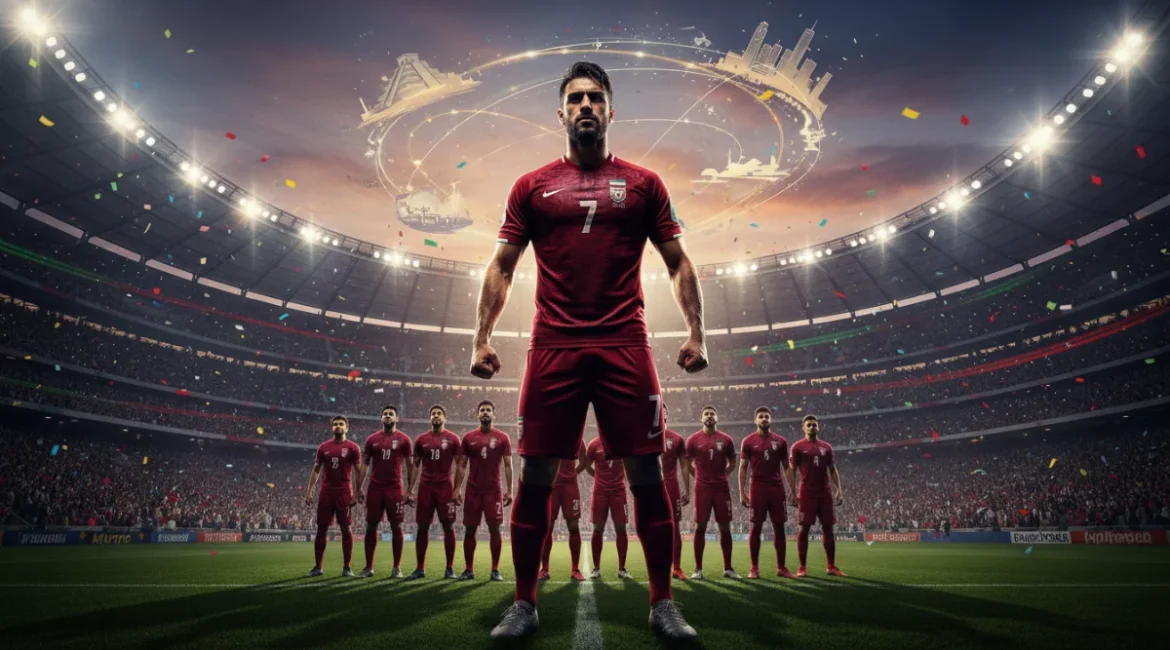
Iran enters the 2026 FIFA World Cup with real momentum, a settled identity, and a rare chance to turn long-standing consistency into something bigger. Team Melli has qualified again, arrives with an experienced coach, and will try to do what no Iranian side has managed before: move beyond the group stage.
Why Iran’s campaign is already unusual
The build-up has not been ordinary. Iran faced an extended visa dispute involving the United States, one of the tournament’s host nations, which created uncertainty around where the squad would stay and how it would travel. FIFA later approved a practical workaround that allows Iran to be based in Tijuana, Mexico, while still playing its matches in the United States.
That compromise matters because it removes a major logistical obstacle without changing the competitive reality. Iran still has to compete on American soil, but the arrangement gives the team a workable training and travel routine. The federation also moved its preparations to Antalya, Turkey, before heading to North America, which helped keep the squad focused while the off-field situation was being sorted out.
The group draw offers a real opening
Iran landed in Group G with Belgium, Egypt, and New Zealand, a draw that feels manageable compared with the toughest possible combinations. Belgium bring the most recognizable talent, even after the fading of their famous golden generation. Egypt add physicality, tournament experience, and a dangerous attacking structure. New Zealand look like the clearest target for points, though Iran cannot afford to treat any opponent as simple in a World Cup setting.
On paper, this is the kind of group where discipline and game management can matter as much as star power. A strong start would transform the entire campaign, while a narrow loss to one of the favorites would still leave Iran with a path to qualification. In the expanded tournament format, even third place can be enough for some teams to advance, which makes every result valuable.
Fixture list and what each match means
Iran opens against New Zealand in Los Angeles on June 15. That match looks like the most important chance to collect three points early and settle nerves. A positive result there would change the tone of the whole group stage, especially because two of Iran’s three matches are scheduled in Los Angeles.
The second match comes against Belgium on June 21, also in Los Angeles. That is the most difficult fixture on paper and likely the one in which Iran will need to be compact, patient, and efficient on the counterattack. The group stage ends against Egypt in Seattle on June 26, a game that could easily decide whether Iran stays alive or goes home. By that point, the math may depend on every goal scored and every goal conceded.
How Amir Ghalenoei has shaped the side
Amir Ghalenoei, now 62, is leading Iran into the finals after returning to the national team in 2023. His qualifying record was strong, with Iran losing only once during AFC qualifying and finishing comfortably at the top of their group. That type of stability is exactly what the team needs heading into a short, high-pressure tournament.
Ghalenoei’s version of Iran is built on organization, familiarity, and a clear understanding of roles. Rather than relying on constant changes, he has preferred continuity. That approach has helped create a squad that knows how to defend in structure, transition quickly, and avoid unnecessary mistakes under pressure.
The players that matter most
Mehdi Taremi remains the central figure. As captain and leading forward, he gives Iran a proven scorer with major European experience and the ability to influence a match even when chances are limited. Around him, Iran also leans on Saman Ghoddos for creativity and Alireza Beiranvand for goalkeeping presence and leadership from the back.
The broader group is a blend of seasoned veterans and players who know each other well from the Persian Gulf Pro League. That familiarity can be an asset in tournament football, where chemistry often matters as much as raw ability. Iran may not have the deepest star roster in the field, but it does have cohesion, which can be decisive over three matches.

What a realistic Iran run could look like
Iran has never reached the knockout rounds at the World Cup, and that history still hangs over every tournament appearance. This squad, however, enters the 2026 edition with a better platform than many of its predecessors. The draw is not overwhelming, the coach has experience, and the team has had time to prepare despite political and logistical distractions.
The most realistic route forward is straightforward: stay organized against Belgium, take care of New Zealand, and make the Egypt match count. If Iran earns enough points early, it can control the pressure rather than chase it. If the team is forced into a must-win situation late in the group, the challenge becomes much steeper.
For supporters, the appeal goes beyond the standings. Iran is usually a difficult team to face because it defends with discipline and attacks with enough speed to punish mistakes. That profile makes Team Melli a dangerous opponent, especially in a tournament where one sharp counterattack can change everything.
Where the story may go next
The next few weeks will reveal whether Iran’s preparation, experience, and unity can finally produce a historic result. The squad has already handled a difficult lead-up, and now the task is to turn that resilience into points. If the opening match goes well, the conversation around Iran will shift quickly from participation to possibility.
For now, the outlook is clear: Iran arrives in 2026 as a disciplined, seasoned, and potentially awkward opponent for anyone in Group G. If everything falls into place, this could be the tournament where Team Melli finally changes its place in World Cup history.