
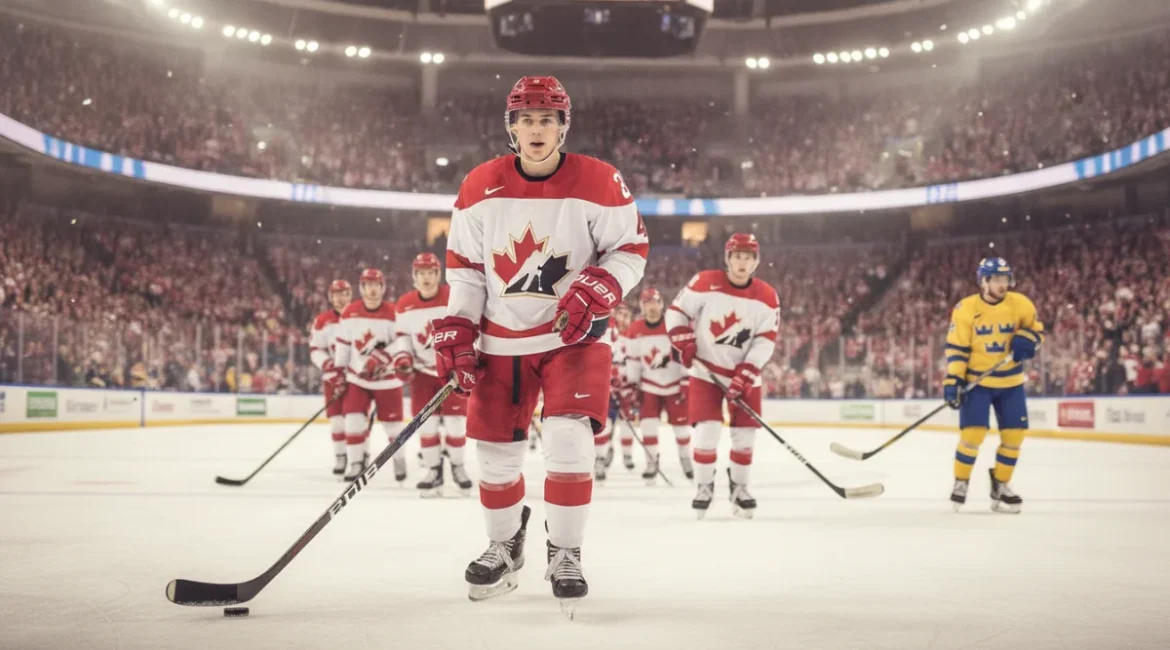
Canada has already booked a spot in the semifinals, but the Hlinka Gretzky Cup is now entering the part of the week that matters most. The final preliminary game against Sweden will help decide momentum, matchups, and whether this Canadian group can carry its fast start into the medal round.
Canada Arrives With Control of Group A
After back-to-back regulation wins, Canada sits first in Group A and no longer needs a result against Sweden to stay there. The team’s early work against Switzerland and Slovakia was enough to secure a semifinal berth and put the Canadians in a strong position heading into elimination hockey.
The matchup with Sweden still carries value, even without direct pressure on the standings. It is the last chance to sharpen details before the tournament shifts from round-robin play to a single-elimination format where one mistake can end a title chase.
What Canada Has Already Shown
The opening two games offered a clear picture of Canada’s depth. The offense has come from multiple lines, the defense has joined the attack, and the team has consistently produced sustained pressure in the offensive zone.
- Canada opened with a 7-3 win over Switzerland.
- The Canadians scored five times in the first period of that game.
- Canada outshot Switzerland 48-25.
- Liam Pue scored twice, and Brock England also finished with two goals after adding a short-handed marker later in the game.
- Canada followed with a 6-1 win over Slovakia.
- Kayden Stroeder scored twice against Slovakia.
- Canada again generated 48 shots while limiting Slovakia to 13.
That kind of balance matters in tournament hockey. Canada has not needed one player to do everything, and that distribution of offense can be a major advantage once games tighten in the semifinal and medal rounds.
Key Canadian Names to Watch
Several players have already separated themselves in the scoring race. Pue, Ryerson Edgar, and Camryn Warren each had four points through the first two games, while Pue led the team with three goals. Maddox Schultz also stood out with four assists, showing that Canada’s production has not been limited to finishing chances.
Other contributors have also made an impact. England, Stroeder, and Benjamin Veitch have all added goals, and Landon DuPont has already entered the conversation as one of the roster’s most closely watched prospects. The early results suggest Canada has the kind of spread-out attack that can survive if one line goes quiet.
| Player | Early Tournament Output | Notable Detail |
|---|---|---|
| Liam Pue | 3 goals, 4 points | One of Canada’s top early scorers |
| Camryn Warren | 4 points | Consistent offensive presence |
| Ryerson Edgar | 4 points | Part of Canada’s balanced scoring |
| Maddox Schultz | 4 assists | Primary setup man so far |
| Kayden Stroeder | 2 goals | Added finishing touch against Slovakia |
Sweden Makes the Final Test More Interesting
Sweden enters the game with more urgency. It beat Slovakia 4-3 to start the tournament, then fell 7-6 to Switzerland in a high-event game that kept its semifinal hopes alive but less certain. A strong showing against Canada would improve Sweden’s position and raise the stakes for the rest of the group.
The Swedes have also shown they can score. Dorian Eklund Aspe reached four points, while Oliver Sundberg and Milan Sundstrom each scored twice in the first two games. That offensive talent means Canada cannot treat the matchup as a formality, even if its own playoff spot is already safe.
Canada also met Sweden in pre-tournament play and won 3-1, but a warm-up game rarely tells the whole story. The group-stage meeting should give a better read on how both teams stack up when tournament points and semifinal positioning are on the line.
- Canada can use the game to test different lines and defensive pairings.
- Sweden can use it to chase a stronger finish in Group A.
- Both teams gain a valuable look at a likely medal-round level of pace and physical play.
- The result will help shape confidence before Friday’s semifinals.
The Bracket Still Leaves Questions
By finishing first in Group A, Canada will face the second-place team from Group B in the semifinals. That opponent is not yet set, since the Group B race is still unfolding. The United States had the early lead after two games, with Czechia and Finland close behind and Germany still searching for its first point.
That uncertainty creates an added layer of preparation. Canada knows it will face a top-tier opponent, but it does not yet know whether that team will be built around pace, structure, or heavy forechecking. The only certainty is that the pressure level will rise sharply once the medal round begins.
The memory of last year’s semifinal loss should also be in the back of the team’s mind. Canada entered the 2025 tournament’s elimination stage undefeated before falling to the United States in a shootout. It later recovered to win bronze, but the title run ended one game too early. That result is a reminder that pool play success does not automatically carry over once the bracket turns unforgiving.
History Raises the Standard Even Higher
Canada does not approach this event like a normal preseason show. Since the summer under-18 tournament began in 1991, the country has captured 25 of the 34 gold medals available. It has also produced two major dynasty runs, winning seven straight titles from 1996 through 2002 and eight in a row from 2008 through 2015.
The expectation gets even stronger when the competition is hosted in Alberta. Before this year, Canada had already won gold in every previous Alberta edition, including Edmonton and Red Deer in 2018, Red Deer in 2022, and Edmonton again in 2024. In that most recent Edmonton run, Canada edged Czechia 2-1 in the gold-medal game at Rogers Place.
That history explains why a semifinal berth is only the beginning. For Canada, anything short of a gold-medal push at home feels incomplete.
Why This Week Matters Beyond the Trophy
The Hlinka Gretzky Cup is also one of the first major checkpoints for players heading toward NHL draft attention. The event brings together a strong group of under-18 talent from leading hockey nations, giving scouts and fans an early look at future high-end prospects before club schedules complicate roster availability.
For Canada, that means the medal round is about more than simply chasing another championship. It is also a stage where players can show poise under pressure and demonstrate how they respond when every shift carries more weight.
DuPont, Pue, Edgar, Warren, Schultz, and Stroeder have all benefited from the strong opening. The next step is proving that the same production can hold up when the game becomes tighter, louder, and more demanding.
The semifinal on Friday, August 7, will tell the real story. Canada has already done the easy part by earning first place in its group; now it has to turn that start into something bigger. If the offense keeps rolling and the defensive pressure stays steady, the Canadians will have a real chance to play for gold on Saturday, August 8.