
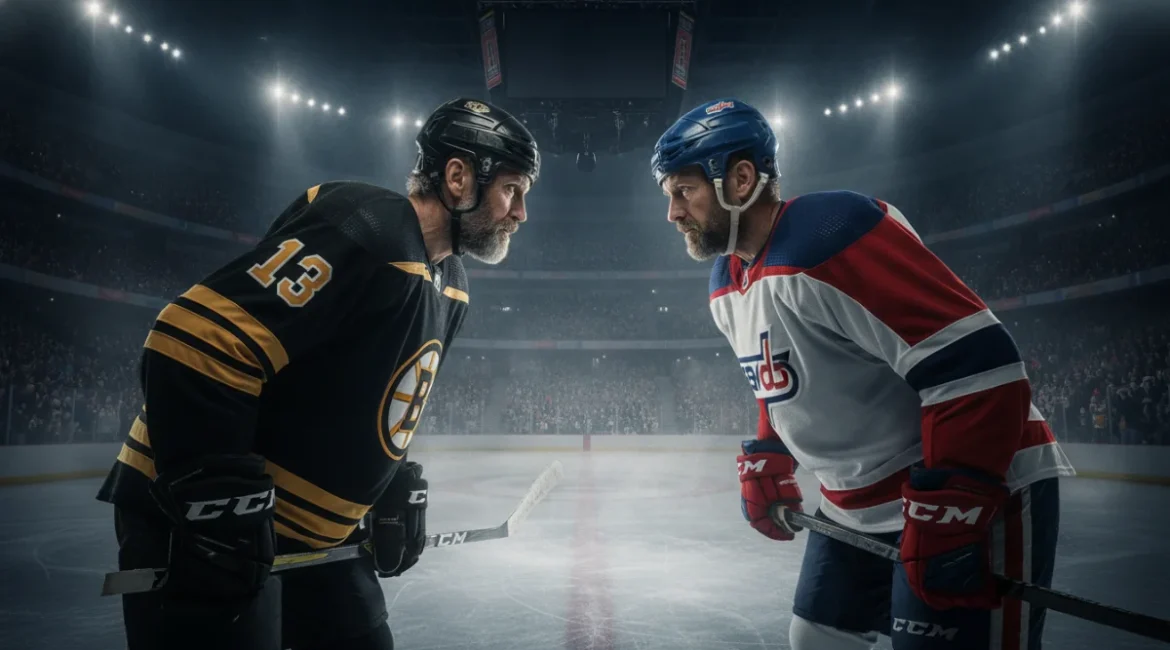
Sidney Crosby and Alex Ovechkin have spent more than 20 years shaping the NHL’s modern identity. When the Pittsburgh Penguins visit the Washington Capitals on Wednesday night, their latest meeting will carry a significance that no previous regular-season matchup could match.
Ovechkin has confirmed that the 2026-27 campaign will be his final NHL season. At 41, the Washington captain is entering his 22nd season and owns the league’s all-time record with 929 regular-season goals. That announcement has changed the meaning of every remaining Crosby-Ovechkin game.
There will still be standings points, power plays, and competitive pressure. Yet the larger story is clear: one of hockey’s defining rivalries is moving toward its final encounters.
A Rivalry Built Across Two Decades
Crosby and Ovechkin arrived in the NHL within one year of each other. Washington selected Ovechkin first overall in 2004, while Pittsburgh chose Crosby with the top pick in 2005.
The comparisons began immediately, but their games developed along very different lines. Crosby became known for his awareness, balance, puck control, passing, and ability to dictate play from the middle of the ice. Ovechkin built his reputation on speed, strength, aggression, and a shot that remains among the most recognizable weapons in hockey.
Those contrasting styles made Penguins-Capitals games unusually compelling. Crosby could influence a shift through possession and playmaking, while Ovechkin could transform a game with one powerful release from the left side.
By April 2026, the two stars had met more than 100 times in the regular season and playoffs. Their rivalry has lasted through multiple NHL eras, coaching changes, roster rebuilds, and changes in how the game is played.
The Postseason Record Adds More Weight
The rivalry became most intense when the stakes were highest. Crosby and Ovechkin have opposed each other in four playoff series, and the winner of each series went on to win the Stanley Cup.
- Pittsburgh defeated Washington in 2009 and later won the championship.
- The Penguins eliminated the Capitals in 2016 before claiming another Cup.
- Pittsburgh again prevailed in 2017 and repeated as champion.
- Washington finally defeated Pittsburgh in 2018 and captured the franchise’s first Stanley Cup.
That final result gave Ovechkin a defining achievement of his own. He won the Conn Smythe Trophy as playoff MVP, while Crosby had earned that honor during Pittsburgh’s championship runs in 2016 and 2017.
In 25 playoff games against one another, Ovechkin has the statistical edge with 33 points, including 15 goals and 18 assists. Crosby has recorded 30 points, with 13 goals and 17 assists. The narrow difference reflects how evenly matched their influence has been despite their contrasting approaches.
The Game That Captured Their Competitive Fire
The 2009 Eastern Conference semifinal remains the clearest snapshot of the rivalry. In Game 2, both captains scored hat tricks, creating one of the most memorable individual duels in playoff history.
Washington won that night, 4-3, but Pittsburgh eventually took the series in seven games. The Penguins continued through the postseason and lifted the Stanley Cup.
That contest showed why the rivalry connected with so many fans. When one star produced a spectacular performance, the other often answered immediately. Their competition was not simply about statistics; it was about raising the level of the entire game.
What Canadian Fans See in Crosby
Crosby’s impact reaches far beyond Pittsburgh. The Nova Scotia native has represented Canadian hockey for more than two decades and remains one of the country’s most prominent athletes.
His overtime goal against the United States in the 2010 Olympic gold medal game in Vancouver became one of the most celebrated moments in Canadian sports. For many Canadian viewers, Crosby represents national hockey excellence in the same way Ovechkin represents an extraordinary international challenge.
Early comparisons often framed the rivalry as Canada versus Russia. Over time, that simple storyline became much broader. The two players were competing to define the same generation, lead their franchises, win championships, and establish individual legacies that would survive their careers.
Key Players and Possible Game Breakers
Sidney Crosby’s Complete Influence
Crosby does not need to score to control a game. His ability to shield the puck, win battles near the crease, create passing lanes, and extend possessions can force Washington’s defense to collapse.
Against the Capitals, Crosby has produced 97 points in 74 regular-season meetings, including 35 goals and 62 assists. If Pittsburgh spends extended time in the offensive zone, he is likely to be involved even when another teammate finishes the play.
Alex Ovechkin’s One-Shot Threat
Ovechkin presents a more direct problem. Opponents know he wants to attack from the left faceoff circle, yet stopping that chance has proven remarkably difficult throughout his career.
His scoring record already places him alone at the top of the NHL’s regular-season goal list. He also enters this final season after leading Washington with 31 goals and reaching at least 30 goals in a record 20 seasons.
On the power play, a single open look could be enough to change the result. Washington will look for ways to give its captain time and space before Pittsburgh can close the shooting lane.
Why This Meeting Feels Like a Milestone
Crosby may have the broader ability to shape possession, while Ovechkin remains the more obvious finishing threat. If the Penguins control the puck, Crosby’s distribution and awareness could determine the pace. If Washington earns power plays or creates clean entries, Ovechkin may need only one opportunity.
The game itself will still matter to both teams. However, its place in hockey history may become more important with time. Fans have watched these players compete for awards, face each other in playoff battles, win Stanley Cups, and break records.
That long continuity is what makes the current moment different. For most of their careers, another Penguins-Capitals matchup was always waiting somewhere ahead. Ovechkin’s decision has removed that assumption.
New stars such as Connor McDavid and Nathan MacKinnon are carrying the NHL into its next era, but reproducing the Crosby-Ovechkin rivalry will be difficult. The timing, longevity, team success, and contrasting identities aligned in a way that rarely happens.
When Pittsburgh and Washington meet tonight, the result will add another chapter to a historic rivalry. It may also become one of the final chances to watch two generational players share the same NHL stage before one of them leaves it for good.