
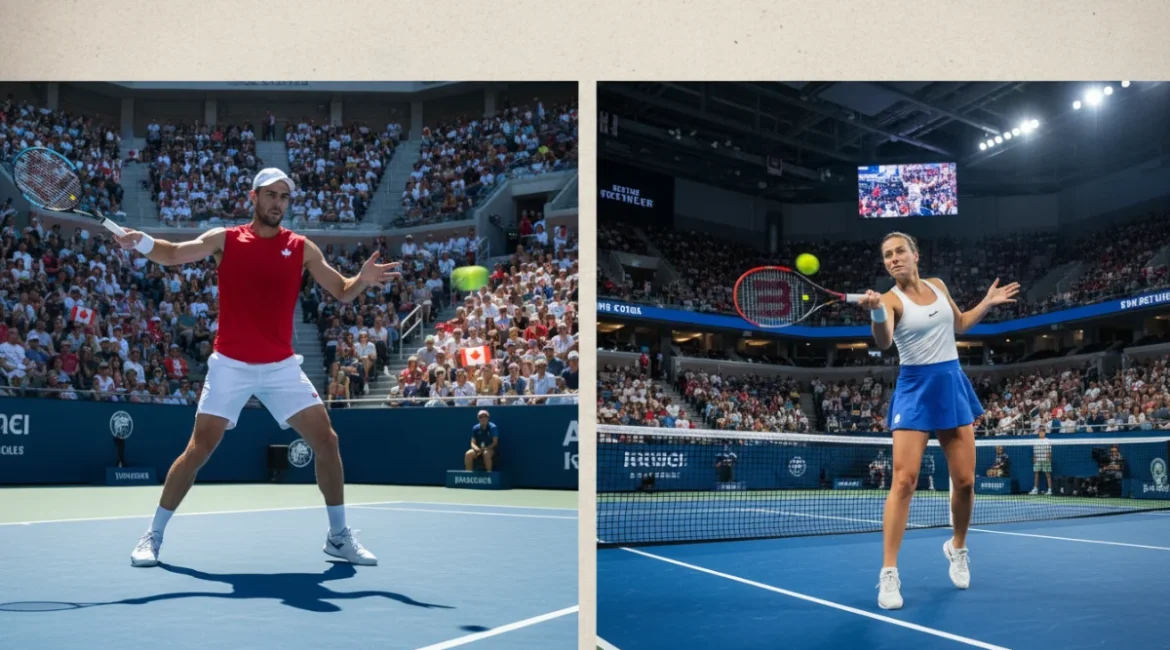
The 2026 National Bank Open is entering its decisive stretch, with the round of 16 spread across Montreal and Toronto on Saturday and Sunday, August 8 and 9. By the end of the weekend, only eight men and eight women will still have a path to the title.
The men’s draw in Montreal has already turned chaotic, while the women’s side in Toronto has followed a more predictable script. That contrast makes this midtournament weekend especially important for fans tracking both the favorites and the surprise contenders.
What the weekend schedule looks like
The round of 16 will be played over two days, and the two host cities will run on slightly different session times. Montreal’s day session on the main court begins at 12:30 p.m., with night play starting at 6:00 p.m. Toronto’s main-court schedule starts at 12:30 p.m. during the day and 7:00 p.m. at night.
Each city will stage eight singles matches across the weekend. The winners advance to the quarterfinals, which are scheduled for Monday, August 10, and Tuesday, August 11.
- Saturday, August 8: round-of-16 action in both cities
- Sunday, August 9: final round-of-16 matches in both draws
- Monday, August 10: quarterfinals begin
- Tuesday, August 11: quarterfinals continue
The exact order of play is usually released the day before, because match length and weather can shift the timetable.
Montreal’s men’s draw has become wide open
Few top seeds survived long in the Montreal field. Alexander Zverev, Daniil Medvedev, Taylor Fritz, and Andrey Rublev were all knocked out in their opening matches, and Félix Auger-Aliassime withdrew because of a back injury. That means six of the top 10 seeds were already gone before the second round ended.
The result is a draw that no longer looks anything like what it did at the start of the tournament. Instead of a few heavy favorites controlling the bracket, Montreal now offers room for momentum players, aggressive shotmakers, and younger names trying to seize a rare opening.
Two of the most interesting threats are listed below:
- Ben Shelton entered as the defending champion and opened with a straight-sets win over Jenson Brooksby.
- Casper Ruud handled Juan Manuel Cerúndolo with ease and looks comfortable enough on hard courts to take advantage of the bracket’s openness.
- João Fonseca delivered one of the tournament’s biggest shocks by eliminating Stefanos Tsitsipas in a tight match.
- Arthur Fils showed his physical style and survived in three sets against Zachary Svajda.
- Tallon Griekspoor produced the most eye-catching result of the men’s event by defeating Zverev after dropping the first set.
Shelton remains the most obvious title contender in Montreal because his serve and first-strike tennis travel well on faster courts. Ruud is a different type of challenge, but his steadier baseline game gives him a real chance to keep advancing if the draw continues to break open.
Why Shelton still feels like the man to beat
Shelton’s case is straightforward: he is the defending champion, he knows how to win this tournament, and the conditions are favorable to his style. His 2025 title run was his first at the Masters 1000 level, and it came with the kind of confidence-building results that can change how a player is viewed.
In 2026, he no longer arrives as a promising upset candidate. He arrives as a proven threat. That shift matters, because the expectations are now higher and opponents will treat every round like a chance to remove one of the draw’s biggest remaining names.
He still needs to manage the swings in his own game. When Shelton lands a high percentage of first serves and stays patient enough to build points, he is extremely dangerous. When he rushes, he can give back control quickly. In a compact, unpredictable field, that balance will decide how far he goes.
Toronto’s women’s draw has kept its shape
The women’s event has been far more orderly. Aryna Sabalenka, Elena Rybakina, Jessica Pegula, Coco Gauff, and Mirra Andreeva all moved through their first assignments and remained on track for the later rounds.
| Player | Opening result | What stands out |
|---|---|---|
| Aryna Sabalenka | Beat Moyuka Uchijima 6-3, 6-3 | Extended her hard-court winning streak to 13 |
| Elena Rybakina | Beat Daria Kasatkina 6-3, 5-7, 6-4 | Mixed heavy power with a high error count |
| Coco Gauff | Beat Kayla Day 6-2, 7-5 | Used defense and speed to win key points |
| Jessica Pegula | Beat Magdalena Frech 3-6, 6-3, 6-1 | Recovered after a slow start and dominated late |
| Mirra Andreeva | Beat Karolina Pliskova 6-0, 6-2 | Produced the most emphatic win among the favorites |
Sabalenka remains the clear benchmark in Toronto. As the world No. 1, she brought a strong hard-court record into the event, and her first-round performance reinforced why she is so difficult to handle on quick surfaces. If she keeps moving through the draw, she will also secure her hold on the top ranking after the tournament.
Rybakina, Gauff, Pegula, and Andreeva all have a case
Rybakina’s opening match showed both her ceiling and her volatility. She struck the ball cleanly enough to hit 58 winners, but she also made 58 unforced errors, which is the kind of split that can either overwhelm an opponent or create unnecessary danger.
Gauff’s opener was less dominant on the scoreboard, but she still found a way through. Her speed, court coverage, and ability to absorb pace continue to make her one of the hardest players to finish off.
Pegula’s value in Canada should never be underestimated. She has already won this event twice, in 2023 and 2024, and her experience in these conditions often matters when the draw tightens and the margins shrink.
Andreeva may have produced the cleanest performance of the group. Her 54-minute demolition of Pliskova was a sign that her movement and decision-making are already translating well to hard courts, even though she is still only 19.
The Canadian spotlight stays on Leylah Fernandez
With Félix Auger-Aliassime out and Gabriel Diallo eliminated, Leylah Fernandez is the last Canadian left in singles. That gives her matchups an added layer of attention at home, especially as the Toronto event moves into its most meaningful rounds.
Fernandez handled Renata Zarazúa convincingly in her opening match, winning 6-2, 6-2 in front of a supportive crowd. She broke serve repeatedly, protected her own delivery well enough, and looked assertive from the start.
Her next challenge is Elise Mertens, a veteran opponent who can extend rallies and force opponents to earn every point. For Fernandez, the formula is simple:
- take the ball early whenever possible
- use the forehand to move the court
- avoid becoming passive in long exchanges
- keep the crowd involved for as long as possible
If she executes that plan, she has a realistic chance to keep Canada’s singles hopes alive deeper into the week.
What to watch when the round of 16 begins
The next two days should clarify whether Montreal’s men’s bracket belongs to Shelton, Ruud, or one of the newer names who have already knocked out established stars. Fonseca’s rise is particularly notable, because victories like his over Tsitsipas can reshape a tournament’s entire atmosphere.
Toronto is different. There, the story is less about chaos and more about which elite player can separate first. Sabalenka looks like the safest pick, but Rybakina’s power, Gauff’s athleticism, Pegula’s experience, and Andreeva’s maturity make the women’s event far from settled.
For Canadian fans, the weekend carries a simple question: can Fernandez extend the home-country presence after so many other local hopes have already faded? The answer will help define the national mood heading into the quarterfinals.