
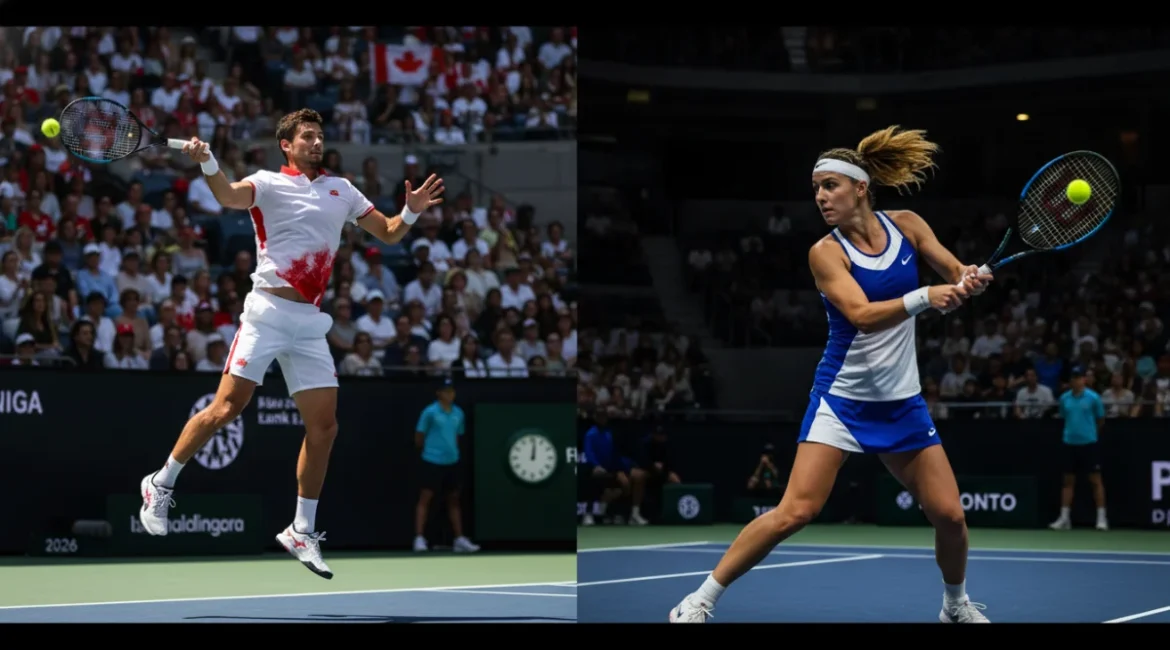
The National Bank Open now turns toward the round of 16, where the bracket begins to narrow fast in both cities. Montreal has become unpredictable on the men’s side, while Toronto still has a cluster of major women’s contenders moving forward.
By the end of the weekend, the field will be trimmed to eight men and eight women. That makes Saturday and Sunday decisive for anyone hoping to stay in the conversation for the title.
What the Round of 16 Means for the Tournament
The next stage is scheduled for Saturday, August 8, and Sunday, August 9, 2026, with both draws moving through a full slate of singles matches. In Montreal, play is set for IGA Stadium, where the day session begins at 12:30 p.m. and the evening session starts at 6 p.m..
Toronto follows a similar rhythm, with center-court action opening at 12:30 p.m. for daytime matches and 7 p.m. for the night session. Each city will stage eight singles matches across the two days, and the winners will advance to the quarterfinals on Monday and Tuesday.
Fans should expect the official schedule to remain flexible. Match length, weather, and court turnover can all affect the final order of play, so the full lineup is usually confirmed close to each session.
Montreal Has Become a Search for Survivors
The men’s event has already delivered several major shocks. Alexander Zverev, Daniil Medvedev, Taylor Fritz, and Andrey Rublev were all knocked out early, and second seed Félix Auger-Aliassime withdrew with a back injury before he could begin his singles campaign.
That kind of turnover has left the draw wide open. Six of the top 10 seeds were gone before the second round ended, which means the players still standing have a real chance to push deep into the week without having to navigate the usual wall of elite opposition.
Ben Shelton still looks like one of the strongest names left in the bracket. The defending champion opened with a 6-3, 7-5 win over Jenson Brooksby, and his serve-heavy, aggressive style suits the quick conditions in Montreal.
Casper Ruud also enters the round of 16 with momentum after a convincing 6-1, 6-2 victory over Juan Manuel Cerúndolo. Ruud’s game is usually associated with clay, but his hard-court experience makes him far more dangerous in a draw that has lost so many established favorites.
Five Storylines That Could Shape the Men’s Side
1. Shelton is no longer just an exciting young player. He is now the reigning champion, and that status brings a different kind of pressure. After winning his first Masters 1000 title in 2025, he will be expected to manage matches with more control and fewer risky swings in momentum.
2. Ruud has one of the clearest paths of any remaining contender. The Norwegian is not facing the same kind of congestion that usually appears in the second week of a Masters event, which gives him more room to build confidence point by point.
3. João Fonseca has already proven he can handle a bigger stage. His win over Stefanos Tsitsipas was one of the most eye-catching results so far, and it suggested that the Brazilian is ready to challenge top-level players with both power and composure.
4. Arthur Fils brings the athleticism needed for this setting. After beating Zachary Svajda in three sets, the Frenchman showed that he can defend, counterattack, and absorb pressure well enough to survive long matches on these courts.
5. Tallon Griekspoor is now more than a surprise name on the board. His comeback win over Zverev, 6-7, 6-2, 6-4, changed the tone of the section he occupies, and that victory should give him real belief heading into the next round.
Canada’s Men Exit Before the Last Sixteen
Canadian hopes on the men’s side faded quickly. Auger-Aliassime, who entered the tournament as the second seed, could not compete because of the back issue that forced his withdrawal.
Gabriel Diallo offered the home crowd a bright start by defeating Kyrian Jacquet for his first main-draw win in Montreal. That progress ended one round later, when he retired against Luciano Darderi while trailing 6-4, 2-3.
As a result, no Canadian man reached the round of 16. Even so, the atmosphere in Montreal should remain strong, because the remaining field still includes several popular and entertaining players with a good chance of producing dramatic matches.
Toronto’s Top Seeds Keep Rolling
The women’s draw has been steadier, and the biggest names have mostly handled their early tests. Aryna Sabalenka, Elena Rybakina, Jessica Pegula, Coco Gauff, and Mirra Andreeva all advanced into the third round, which keeps the top of the bracket loaded with proven quality.
Sabalenka remains the most obvious player to beat. The world No. 1 opened with a 6-3, 6-3 win over Moyuka Uchijima, extending her hard-court winning streak to 13 matches and reinforcing how well her first-strike game fits Toronto’s pace.
Rybakina had to work harder, but the second seed still moved through Daria Kasatkina in three sets, winning 6-3, 5-7, 6-4 after two hours and 33 minutes. She struck 58 winners, but she also made 58 unforced errors, which shows both her ceiling and her risk level in one match.
Toronto’s Favorites Are Still Under Pressure
Gauff’s opening win over qualifier Kayla Day was controlled but not effortless. The fourth seed relied on her movement and defense to take the key points, which is often how she turns tight sets in her favor when opponents try to overpower her.
Pegula had the most difficult first match of the group. After losing the opening set to Magdalena Frech, she steadied herself and ran away with the final two sets, eventually winning 3-6, 6-3, 6-1 after taking eight of the last nine games.
That kind of finish is one reason she has become so reliable in Canada. Pegula has already won this event twice, in 2023 and 2024, and she understands how to handle the summer hard-court swing better than most of the field.
Andreeva may have produced the most complete performance of the group. The French Open champion dismissed Karolina Pliskova 6-0, 6-2 in just 54 minutes, then reminded everyone that her age does not match the maturity of her game.
She reads rallies well, changes pace naturally, and rarely gives away easy points. If she carries that level into the second week, she becomes much more than a rising prospect.
Leylah Fernandez Is Still Canada’s Lone Hope
Leylah Fernandez is the final Canadian left in either singles draw after beating Renata Zarazúa 6-2, 6-2. Playing in front of the center-court crowd, she served well, returned with purpose, and broke her opponent five times.
Her next task is tougher. Elise Mertens has the experience to slow matches down, extend rallies, and test Fernandez’s patience across longer exchanges.
For Fernandez, the formula is clear. She will need to stay aggressive, take the ball early, and keep using her forehand to move opponents off balance. When she commits to that style, she can be highly dangerous against any player in the field.
How Viewers Can Follow the Action
Sportsnet and TVA Sports are the main Canadian broadcasters carrying the National Bank Open throughout the tournament. Their coverage includes matches from both Montreal and Toronto, and each network also offers digital viewing options for fans who want to stream the action.
Because the order of play can shift from session to session, viewers will want to check the latest schedule before matches begin. That is especially important in a week like this, when long rallies and weather delays can alter the timing of later contests.
The weekend should reveal which favorites are truly positioned to make a run and which underdogs can keep extending the chaos. In Montreal, the men’s bracket has already lost too many seeds to feel predictable, while Toronto still has enough depth to produce several high-quality clashes.